You hear about SEO, social media, email campaigns, paid advertising, content, websites, analytics, and dozens of other tactics. Digital Marketing 101 with practical strategies can seem like you need to learn everything before you can get results.
If you are starting today your goal should be much simpler: reach the right people, give them something useful, build trust, and make it easy for them to take the next step.
In this guide, I’ll walk you through the most important steps so you can build a practical marketing system without wasting time chasing likes, followers, or traffic that never becomes a customer.
Understand What Digital Marketing Is
Digital marketing is the process of promoting a business, product, or service through online channels.
This can include:
- Search engines
- Websites
- Social media
- Online advertising
- Video
- Content
But don’t make the mistake of thinking digital marketing means being active everywhere.
You don’t need to post on every social platform, run several advertising campaigns, and publish content every day.
You need to identify where your potential customers are and how they make buying decisions.
For example, if your customers search Google when they need a solution, SEO and useful website content may be important.
If they discover products through short videos, social media may be a better starting point.
If you sell services to business owners, email and LinkedIn may be more useful.
The right strategy depends on your audience.
Step 1: Know Who You are Trying to Reach
Before creating an advertisement, writing a blog post, or sending an email, decide exactly who you want to reach.
One of the biggest mistakes beginners make is trying to market to everyone.
Instead, get specific.
Ask yourself:
- Who is most likely to need my product or service?
- What problem are they trying to solve?
- What have they already tried?
- What questions do they have?
- What prevents them from buying?
- Where do they look for information?
- What would make them trust my business?
For example, saying:
“I help businesses with marketing.”
is broad.
Something like:
“I help small businesses attract customers through affordable online marketing.”
is much clearer.
Once you understand your audience, your marketing becomes easier.
You know what topics to write about, what offers to create, what language to use, and where to promote your business.
Start With One Customer Problem
Don’t try to solve every problem your audience has.
Choose one important problem and build your first marketing efforts around it.
If you can clearly explain the problem and show how your product or service helps solve it, your message becomes much stronger.
Step 2: Build a Website That Turns Visitors Into Leads
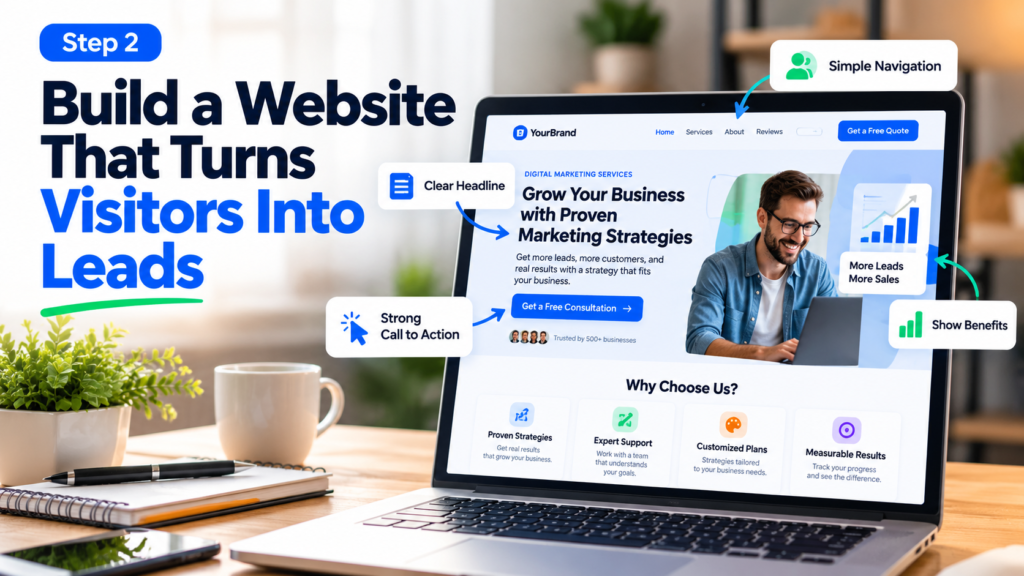
Your website is often the place where people decide whether to learn more, contact you, or leave.
Think of it as your online storefront.
If it’s slow, confusing, difficult to use, or unclear about what you offer, potential customers can disappear before you get the opportunity to speak with them.
A good business website should quickly answer four questions:
What do you offer? Who is it for? Why should I trust you? What should I do next?
Your important pages should include:
- A clear headline
- A simple explanation of your offer
- Benefits for the customer
- Reviews, testimonials, or examples
- Relevant images
- Contact information
- A clear call to action
Your call to action might be:
Get a Free Consultation, Download the Guide, Start a Free Trial
Request a Quote, Shop Now
Don’t give visitors ten different things to do, give them one clear next step.
Traffic Isn’t Enough
Getting people to your website is only part of the job.
If 1,000 people visit your site but nobody contacts you, signs up, or buys anything, the traffic isn’t doing much for your business.
That’s why your website needs to be designed around the action you want visitors to take.
Step 3: Use SEO to Get Found in Search
Search engine optimization, or SEO, helps your website appear when people search for information, products, or services related to your business.
The basic idea is simple: your customers have questions, they type those questions into a search engine, and you create useful content that answers them.
For example, if you sell website hosting, people might search for:
- Best web hosting for beginners
- Cheap web hosting for small businesses
- How to choose web hosting
- Best hosting for WordPress
- Website hosting comparison
These searches can become opportunities to bring potential customers to your website.
Step 4: Create Content That Helps People Make Decisions
Content marketing isn’t about publishing as many articles as possible.
It’s about creating information that your audience actually needs.
Before creating a piece of content, ask:
What problem does this solve?
For example, if you sell accounting software, you could create:
- How to Track Business Expenses
- Best Accounting Software for Small Businesses
- How to Create an Invoice
- Accounting Software Comparison
- Common Small Business Accounting Mistakes
Notice that each topic answers a specific question.
Some people are simply looking for information.
Others are comparing products.
Some are already looking for something to buy.
Your content can help them move from one stage to the next.
Use Different Types of Content
You can create:
How-to content
Show people how to solve a problem.
Buying guides
Help people choose a product or service.
Comparisons
Explain the differences between options.
Reviews
Give an honest assessment of a product.
Case studies
Show how a product or service helped someone.
Educational articles
Explain an unfamiliar topic clearly.
The closer your content is to a real customer problem, the more useful it becomes.
Step 5: Use Paid Advertising Carefully
Paid advertising can help you reach potential customers faster.
You can advertise through platforms such as Google, Facebook, Instagram, LinkedIn, and other networks.
But advertising isn’t simply about putting money behind a post.
You need to know:
- Who you’re targeting
- What you’re offering
- Why they should care
- Where the advertisement sends them
- What action you want them to take
- How much a lead or customer is worth
Don’t Start With a Hard Sell
If someone has never heard of your business, asking them to immediately buy an expensive product may not work.
A better approach can be to offer something useful first.
For example:
Advertisement → Free Guide → Email Signup → Helpful Information → Offer
You could offer:
- A checklist
- A free consultation
- A useful guide
- A free trial
- A discount
- A product demonstration
This gives people a reason to engage with your business before you ask for the sale.
Start With a Small Test
If you’re new to paid advertising, don’t spend your entire budget immediately.
Start with a small amount.
Test your message, audience, offer, and landing page.
Then look at the results.
If something works, improve it.
If it doesn’t, find out why before spending more.
Step 6: Build an Email List
Email marketing is still an important way to stay connected with potential customers.
The reason is simple.
Someone may visit your website today and leave without buying anything.
If you have their permission to contact them by email, you have another opportunity to provide useful information and eventually introduce an offer.
Start by creating a simple lead magnet.
For example:
Free Digital Marketing Starter Checklist
A visitor enters their email address and receives the resource.
You can then send useful emails such as:
- Marketing tips
- Helpful guides
- New articles
- Product recommendations
- Case studies
- Special offers
Don’t make every email a sales pitch.
Give people useful reasons to keep opening your emails.
Keep Your Email Strategy Simple
A beginner-friendly sequence could look like this:
Welcome email → Helpful tip → Useful resource → Product recommendation → Special offer
The goal is to build a relationship rather than pressure people into buying.
Step 7: Choose the Right Social Media Platform

The Best Social Media Marketing Strategy – Full Masterclass
Choose the platforms where your target customers actually spend time.
For example:
- Instagram: visual products and lifestyle businesses
- TikTok: short-form educational and entertaining content
- YouTube: tutorials, reviews, demonstrations, and educational content
- LinkedIn: professional and business audiences
- Pinterest: visual content and website traffic
- Facebook: communities, local businesses, and broad consumer audiences
The best platform isn’t necessarily the one with the most users.
It’s the one where your customers are most likely to pay attention.
Don’t Focus Only on Followers
Having thousands of followers can look impressive, but followers aren’t the same as customers.
Instead, pay attention to:
- Website visits
- Email signups
- Product inquiries
- Leads
- Sales
Your social media activity should ultimately support your business goals.
Step 8: Give People a Clear Reason to Take Action
People may like your content and still do nothing.
That’s why you need a clear offer.
Depending on your business, you could offer:
- Free consultation
- Free trial
- Discount
- Free guide
- Product demonstration
- Free quote
- Newsletter
- Downloadable checklist
Your call to action should tell people exactly what happens next.
Instead of:
“Learn More”
you could use:
“Get Your Free Marketing Checklist”
Instead of:
“Contact Us”
you could use:
“Request a Free Quote”
Small changes like these can make your next step much clearer.
Step 9: Build Trust Before Asking for the Sale
People don’t automatically trust a business just because it has a website.
You need to give them reasons to feel comfortable buying from you.
You can build trust through:
- Customer reviews
- Testimonials
- Case studies
- Product demonstrations
- Clear pricing
- Helpful content
- Transparent policies
- Examples of your work
- Professional contact information
If you’re recommending products as an affiliate, be honest about both the advantages and disadvantages.
Don’t tell someone a product is perfect if it isn’t.
Explain who it’s good for, who may want another option, and what buyers should know before purchasing.
Honest recommendations can help you build long-term credibility.
Step 10: Track What Is Actually Working
You don’t need complicated reports when you’re starting.
Focus on a few important numbers.
Track:
- Where your visitors come from
- Which pages receive the most traffic
- Which content gets clicks
- How many people become leads
- How many leads become customers
- How much you’re spending on advertising
- How much revenue your marketing generates
For example, imagine you spend $100 on advertising and generate 20 leads.
Your cost per lead is:
$100 ÷ 20 = $5
Now you can compare that cost with the value of those leads.
If those 20 leads generate profitable customers, you have something worth improving.
If they generate nothing, you need to investigate the problem.
Maybe the audience is wrong.
Maybe the offer isn’t attractive.
Maybe the landing page needs improvement.
Maybe you’re targeting people who aren’t ready to buy.
The numbers help you identify where to focus.
What Should You Start With?
If you’re starting from zero, don’t try to implement everything at once.
Start with these five steps:
1. Choose Your Audience
Know exactly who you’re trying to reach.
2. Identify One Important Problem
Understand what they need help solving.
3. Create a Useful Offer
Give them a clear reason to choose your business.
4. Choose One Main Traffic Channel
Start with SEO, social media, email, or paid advertising based on where your customers are.
5. Create a Lead System
Give visitors a way to stay connected with your business.
Once you have this foundation, you can add other marketing channels.
Final Thoughts
Digital marketing doesn’t have to feel complicated when you’re just getting started. You don’t need to use every platform, run multiple campaigns, or spend a large budget to begin seeing progress.
Start with the fundamentals: know your audience, understand their problem, create something useful, and give them a clear next step.
Use SEO and content to attract the right people, your website to turn visitors into leads, email to stay connected, and paid advertising when you’re ready to reach more potential customers. Most importantly, track your results so you can see what’s working and where you need to improve.
Don’t try to build everything at once. Choose one audience, one main marketing channel, and one clear goal. Take action, learn from the results, and improve your approach as you go.
The best time to build your digital marketing strategy is before you need more customers. Start with one step today, and build from there.
Ready to Build Your Marketing Plan?
If you’re unsure which strategy makes the most sense for your business, start by identifying your audience, your main customer problems, and the action you want visitors to take.
From there, you can choose the right marketing channel and build a simple path from visitor to lead to customer.
The goal is to make your marketing work harder for your business.